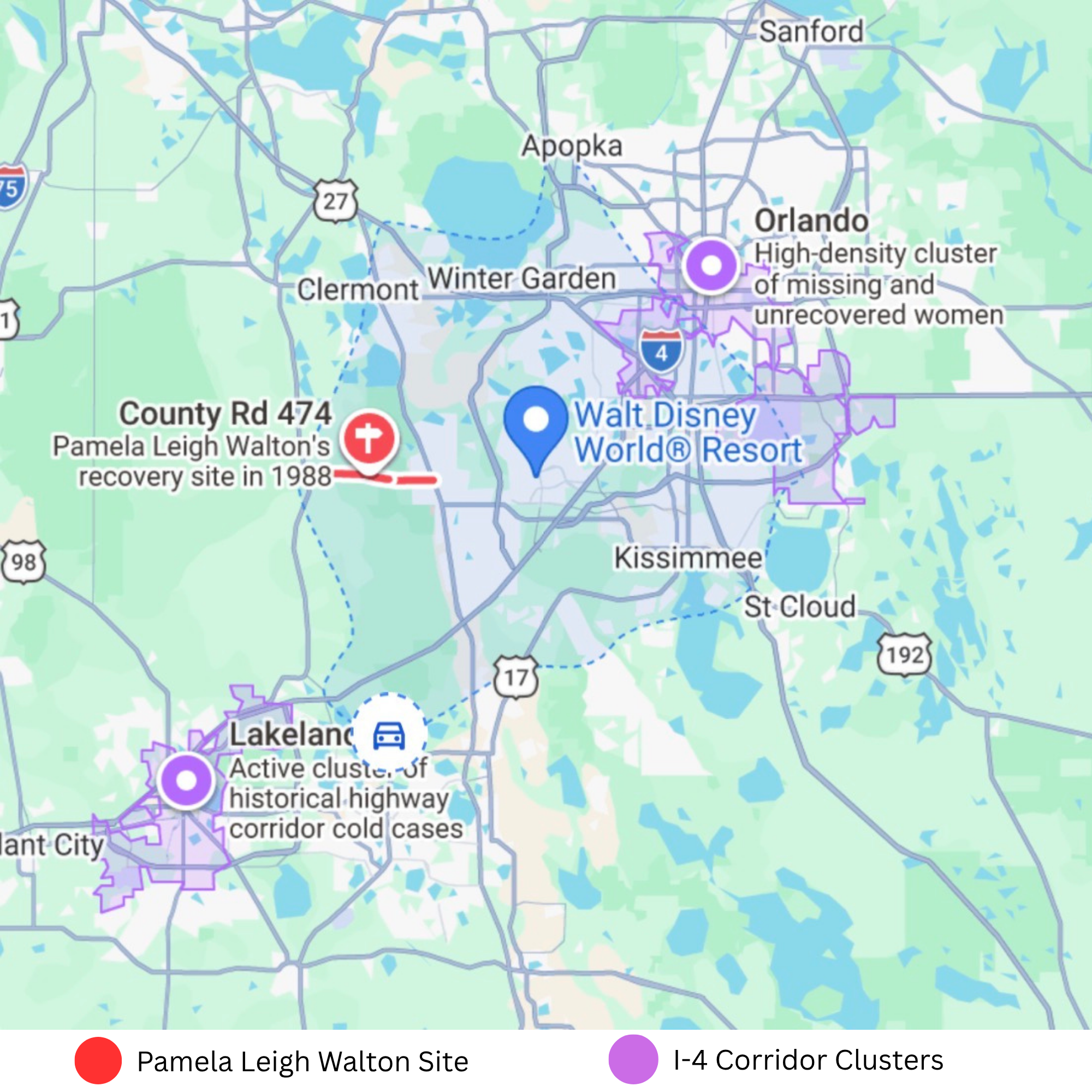
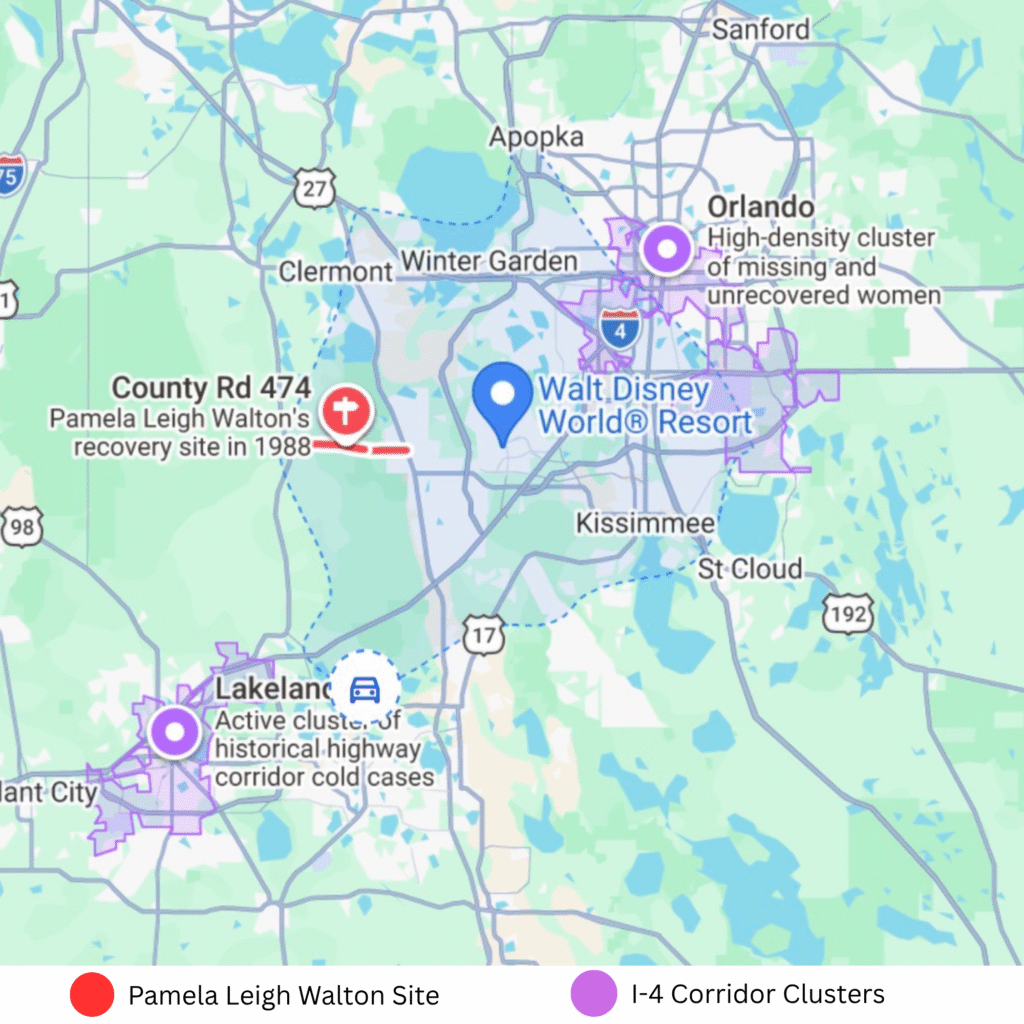
Central Florida – Millions of travelers navigate Interstate 4 in Central Florida every single year, completely unaware of the dark investigative mysteries embedded along the shoulder. For nearly four decades, one of the corridor’s most haunting cold cases involved a homicide victim discovered in the brush off County Road 474 in Clermont, known to local detectives simply as “Julie Doe.”
- The Discovery: A citizen searching for firewood stumbled upon hidden human remains in September 1988.
- The Breakthrough: A dynamic 2025 genetic breakthrough finally restored her true identity as Pamela Leigh Walton.
- The Scale: Pamela’s tragic story belongs to a much larger, chilling pattern of at least 19 other women who vanished or were found dead along this exact highway network.
The stark contrast between the vacation destination image of the I-4 corridor and the anonymity of its forgotten victims highlights the darkness hiding in places we pass in our every day lives.
The 37-Year Search for Pamela Leigh Walton
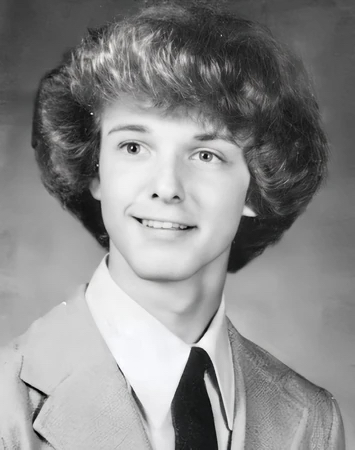
When Lake County investigators initially processed the 1988 crime scene, a series of early forensic misidentifications sent the homicide case down a decades-long dead end.
The timeline to justice required a complete rewriting of the case files:
- The Biological Twist: In 2015, advanced genomic sequencing revealed “Julie Doe” was a transgender woman, completely shifting the parameters of active missing persons databases.
- The Podcast Connection: The critical break came when a true-crime podcast listener opted into a law enforcement data-sharing box on a consumer DNA profile. This single digital click provided genealogists with the exact matching segment needed to build her family tree.
- The Return Home: In March 2025, her name was officially restored. Pamela’s remains have since been repatriated from Florida to her native Kentucky.
The Shadow of the I-4 Corridor
While the identification of Pamela Leigh Walton marks a monumental victory for forensic genealogy, the criminal investigation into her death remains wide open.
More importantly, independent researchers note that her file is part of a broader, systemic highway anomaly. The I-4 corridor has long served as a high-density hunting ground for opportunistic predators—including long-haul trucker serial killers—who utilize the rapid transit lines and deep anonymity of the open road to evade local police tracking. At least 19 other families are still waiting for the exact same forensic closure that Pamela’s family received.
A Producer’s Ethical Blueprint
As a professional TV producer and the executive creator of 15 Minutes of Murder, I look at these highway tracking files through a structural storytelling lens.
“When you sit in a post-production studio analyzing a cold case, you realize your deepest ethical obligation is to strip away the anonymity surrounding these victims,” the 15MM Producer noted. “A highway shouldn’t be allowed to erase a human life. True-crime media has a responsibility to look past the tourist brochures, center the victims, and expose the broader regional patterns that allowed these predators to operate in plain sight. True justice requires a consistent, independent look into the darkness.”
Giving Back Their Real Life

While working on a story for 15 Minutes of Murder, our teams first goal is to give a person their real life back. The 15MM Producer notes, “A standard police case file only demands clinical numbers, biological metrics, and hard evidence. But our ultimate goal with After Dark is to look past the ink to give this person their real life back—to remember their closest friends, their favorite songs, their favorite foods, and all the normal, everyday things that truly defined them. When a tragedy like this occurs on the highway, a person gets lost in the darkness first, and then they get lost a second time when they are reduced to just an anonymous folder sitting in a cold filing cabinet.”
Tonight at 8:00 PM: 15 Minutes of Murder officially premieres its highly anticipated new series, 15 Minutes of Murder presents After Dark — The Corridor. Put on your headphones, turn the lights down, and join our team as we step directly into the forensic files and the deep haunting history of Florida’s I-4 corridor. Available on all official podcast channels.
Have Information? The homicide investigation into Pamela Leigh Walton’s death remains wide open. Anyone with tips regarding her time in Central Florida or Kentucky in 1988 is urged to contact the Lake County Sheriff’s Office Cold Case Team at 352-343-9529, or via email at ColdCase@lcso.org. Anonymous tips can also be submitted through Crimeline at 800-423-8477.